
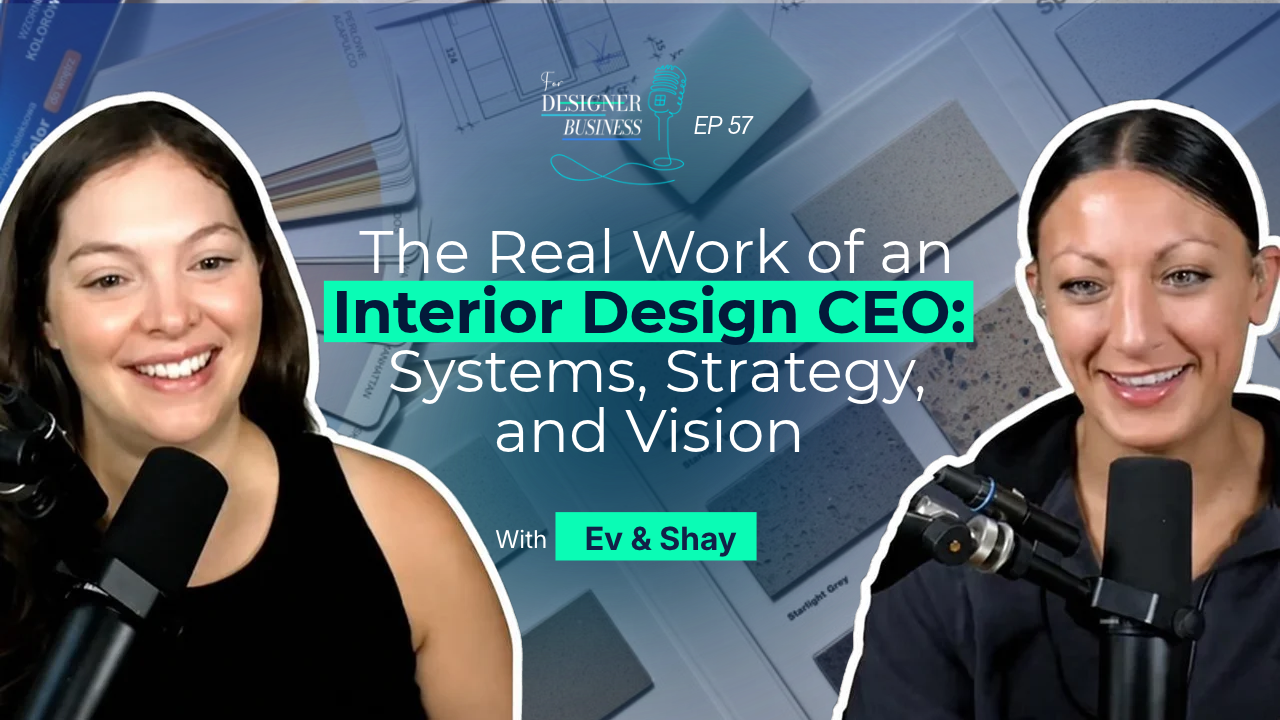
The Real Work of an Interior Design CEO: Systems, Strategy, and Vision
Are You Running Your Interior Design Business, or Is It Running You?
How many days have you spent working inside your projects, answering client questions, solving problems, and putting out fires, only to reach the end of the month and realize you barely worked on the business?
It happens easily.
When you're growing an interior design business, there is always something that feels more urgent. A client needs an answer. A project needs your attention. An installation has a problem. A team member needs direction. There is always another task that seems more directly connected to revenue.
But if you keep giving every available hour to the work in front of you, who is working on the business you are trying to build?
That is the shift at the heart of Episode 57 of For Designer Business. The goal isn't to stop being involved in your business overnight. It's to start making intentional space for the work only you, as the business owner and CEO, can do.
Because growth requires more than getting better at design.
It requires learning how to lead the company.
What We're Getting Into in This Episode
In this episode, Shayna and Evelyn unpack what the CEO role actually looks like for an interior design business owner:
Why being busy can become a ceiling on your growth, even when that hustle is what got you this far.
Why your vision cannot stay in your head if you want other people to execute it the way you intend.
How documenting systems and processes creates leverage, consistency, and greater independence from the owner.
Why networking is more than attending an event, and why nurturing relationships over time is where the real opportunity develops.
How identifying your weaknesses can make you a stronger leader, especially when you build accountability and support around them.
Why understanding your financials is a CEO responsibility, not something you should completely hand off to someone else.
The bigger question is simple: what are you doing each week to actually move the business forward?
When Being the Hustler Starts Holding Your Business Back
In the early stages of an interior design business, doing everything yourself can feel like the only option.
You source. You sell. You manage projects. You answer emails. You create presentations. You solve problems. You figure things out as you go.
And it works.
At least for a while.
You prove to yourself that you can make the business work. You have flexibility. You have clients. You are making money. You are your own boss.
But eventually, the same hustle that helped you build the business starts creating a ceiling.
As the volume increases, everything becomes harder to hold together. Processes are created on the fly. Every project gets handled slightly differently. Decisions live in your head. You become the person everyone needs to ask.
That is often a growth marker, even if it doesn't feel like one.
The problem isn't that you're working hard. The problem is that the business has become dependent on your ability to keep working hard.
All the hustle in the world can still put a ceiling on your business.
The next stage requires a different skill set.
You have to move from being the person who does everything to being the person who creates the structure that allows the business to work.
Your First CEO Responsibility: Turn Your Vision Into Systems
One of the biggest responsibilities of an interior design CEO is driving the vision and strategy of the company.
But having a vision isn't enough.
If your entire way of running the business lives inside your head, your team cannot consistently operate from it.
Your brain may be the smartest technology in your business, but it is also a single point of failure if nobody else can access what you know.
This is where systems and standard operating procedures become important.
What this actually looks like
Start documenting the things you already know how to do.
Don't wait until you have the perfect SOP template. Don't wait until you have time to turn every process into a beautifully organized manual.
Start by getting the knowledge out of your head.
Write down:
What needs to happen
In what order
Why it matters
What a successful outcome looks like
What someone should watch out for
What decisions need your approval
What can be handled independently
The goal isn't documentation for documentation's sake.
The goal is to make your thinking transferable.
And there is an important distinction here: your team needs more than a list of steps. They also need to understand what good looks like according to your company.
If you are handing off procurement, for example, the process might explain how an order gets placed. But your definition of success might include orders being placed promptly, information being communicated clearly, and you never having to ask twice.
That context is part of the system too.
Where this goes wrong
Many business owners think they need to have the entire system figured out before they document it.
You don't.
The process can be improved later. Someone with stronger operational skills can help clean it up, fill gaps, and make it easier to follow.
Your job is to start getting the knowledge out of your head.
Your vision becomes more valuable when someone else can understand and execute it.
And every time a problem happens, there is another opportunity to strengthen the system.
A damaged light fixture, a missed deadline, a communication breakdown, or a project bottleneck can become a lesson. Solve the immediate problem, then ask what needs to change so the same problem is less likely to happen again.
That is how systems mature.
Your Second CEO Responsibility: Build Relationships Before You Need Them
Marketing isn't only about posting content or generating immediate leads.
As the owner, you also have a role in building the relationships that can create future opportunities for your interior design business.
That could mean networking with contractors, organizers, attorneys, complementary professionals, other designers, or people connected to the clients you want to serve.
But there is an important distinction between networking and relationship building.
Showing up to one event is networking.
Following up, staying connected, checking in, and remaining useful over time is relationship building.
The value usually isn't created in the first conversation.
It develops through consistency.
Think of your network like a garden. You can't water it once and expect it to keep growing forever.
What to do instead
Create a simple rotation for staying in touch with the people who matter to your business.
That might look like:
Following up after meeting someone new
Checking in periodically
Sharing something useful or relevant
Congratulating people on milestones
Making introductions when you can
Staying visible within professional communities
Reconnecting with people you haven't spoken to recently
The goal isn't to constantly sell.
It's to stay top of mind.
When the right opportunity comes up, you want your name to already be associated with the kind of work you do.
The magic isn't always in the first conversation. It happens through consistency over time.
Your Third CEO Responsibility: Know Your Weaknesses Without Judging Yourself for Them
There is a particular trap that successful interior designers can fall into.
You know how to do almost everything because you had to learn how to do almost everything.
That creates confidence, but it can also create resistance to letting go.
The question isn't whether you can do something.
You probably can.
The better question is whether you should still be the person doing it.
Maybe you can write the newsletter, but someone else can do it in an hour instead of three.
Maybe you are excellent at developing the vision but struggle with slowing down enough to document the implementation details.
Maybe you understand marketing but don't consistently follow through on the strategy.
Maybe you're strong at solving problems but weak at building repeatable processes around those solutions.
These aren't character flaws.
They're leadership information.
What to do instead
Get honest about where you tend to fall off.
Then build structured support around those weaknesses.
That support doesn't necessarily have to mean hiring a full-time executive immediately.
It could start with:
A monthly accountability meeting
Someone reviewing your marketing metrics
An operations professional helping develop your processes
A fractional leadership resource
A team member taking ownership of a task you consistently avoid
A regular review of your financial performance
The level of support can grow as the business grows.
The important thing is that you stop expecting yourself to become excellent at every single function simply because you're the owner.
A strong CEO doesn't pretend to have no weaknesses. A strong CEO builds support around them.
Your Financials Are a CEO Responsibility Too
There is another part of running an interior design business that is easy to outsource completely: the numbers.
You may have an accountant. You may have a bookkeeper. You may eventually work with a fractional CFO.
Those people can provide incredibly valuable support.
But they shouldn't replace your understanding of the business.
Your financial team sees what is on the books.
You also need to understand what is happening in the business, what is coming, what the business can realistically carry, and what you can afford to invest in next.
That means staying close to your numbers.
When a project wraps, look at its profitability.
Understand how much revenue you need to bring in to cover your obligations.
Know what you're bringing in above that line.
Then use that information to make better decisions about hiring, delegation, marketing, operations, and support.
This is what makes financial information useful.
You're not looking at numbers simply to know what happened.
You're using them to decide what happens next.
The Work That Doesn't Pay You Today May Be What Builds the Business Tomorrow
This is probably one of the hardest mindset shifts for an interior design business owner.
Documentation doesn't immediately bring in a new client.
A networking follow-up may not produce revenue that afternoon.
A monthly accountability meeting doesn't complete a project.
Reviewing your profitability doesn't create another sale.
But these are the activities that create a business capable of supporting future growth.
That is the CEO work.
It is often the work that feels least urgent because there isn't always an immediate financial reward attached to it.
But if you never make time for it, you stay trapped in the cycle of doing.
The goal isn't to stop working.
It's to make sure some of your work is building the machine that will eventually make the business less dependent on you.
What Happens When the Owner Can't Be There?
There is no better reminder of the importance of systems than an unexpected disruption.
In the episode, Shayna shares what happened when she broke her pelvis.
Suddenly, the work she had planned to do couldn't happen. She couldn't simply keep pushing through the way she normally would.
And because the business didn't have enough organization and systems in place at the time, the answer became putting more people into the problem.
That's an understandable reaction when you're drowning.
More work comes in. Add more people.
But without systems, more people don't automatically create a better business. They can also create more complexity, more cost, and more things for the owner to manage.
The deeper lesson is this:
Your systems aren't just there for efficiency. They're there for resilience.
People will be unavailable.
Employees will leave.
Clients will have emergencies.
You will have unexpected things happen in your own life.
A business that depends on the owner being available for every decision is fragile.
A business with documented processes, clear responsibilities, financial awareness, and trained people has a better chance of continuing to operate when something unexpected happens.
And that's ultimately what you're building.
Not just a successful design practice.
A business that can stand on its own.
The CEO Time Block You Keep Postponing Matters
If you're waiting for a quiet week to finally work on your business, you may be waiting forever.
There will always be another client request.
Another project deadline.
Another fire.
Another reason to push the CEO work to next week.
So make the time non-negotiable.
Start with one hour.
During that hour, choose one responsibility:
Document a system
Build or nurture a strategic relationship
Work on a weakness with accountability and support
Review your business numbers and profitability
Clarify your vision or the next strategic priority
You don't need to transform the entire business in one afternoon.
You need to create a consistent practice of stepping out of the project work long enough to lead the company.
As the episode puts it, whether you're acting like it or not, you are already the CEO.
The question is whether you're consistently making time to act like one.
“Standout Lines”
“Your brain is the smartest technology in your business. But your business can't grow if all the knowledge stays in your head.”
“The goal isn't to do everything yourself better. It's to build a business that doesn't require you to do everything.”
“You are the CEO of your business, whether you're acting like it or not.”
The Next Step Is Smaller Than You Think
You don't need to overhaul your entire business this week.
Pick one of the three core CEO responsibilities from this episode: documenting your systems, building strategic relationships, or strengthening your weaknesses.
Then put one hour on your calendar.
Not someday.
This week.
Protect that hour the same way you would protect an important client meeting.
Because the transition from doing everything yourself to actually leading your company is one of the biggest shifts you'll make as an interior design business owner. Your determination and grit got you here. Now that same discipline needs to move into how you lead.
If this is a transition you've been navigating, listen to Episode 57 of For Designer Business, “The Real Work of an Interior Design CEO: Systems, Strategy, and Vision.” The conversation will help you look at your role differently and identify where you need to start making space for the CEO work your business needs.
You don't have to figure it all out at once.
You do need to stay consistent.
And when you know where you need support, don't judge yourself for it. Build the support, protect the time, and keep moving forward.
That's how you move from hustling inside the business to actually leading it.
FAQ
What does a CEO do in an interior design business?
An interior design CEO is responsible for the company's vision, strategy, financial awareness, systems, relationships, and long-term growth. As the business grows, the CEO's role shifts from doing every task to creating the structure and support that allows others to execute effectively.
How can an interior designer stop doing everything themselves?
Start by identifying tasks you repeatedly perform that could be documented, delegated, or supported by someone else. Document the process, clarify what success looks like, and gradually build accountability and support around the areas where you are no longer the best person to do the work.
Why are systems important for an interior design business?
Systems turn the owner's knowledge into repeatable processes that other people can follow. They create consistency, make delegation easier, and reduce the business's dependence on the owner being available for every decision.
What should an interior design business owner focus on each week?
A business owner should consistently make time for CEO-level work such as developing the company's vision and strategy, documenting systems, nurturing strategic relationships, reviewing financial information, and addressing weaknesses through structured support.