
How to Build a Consistent Marketing Strategy for Your Interior Design Business
Are You Marketing Your Interior Design Business Only When You Need Clients?
Have you ever been completely underwater with client work, only to look up a few months later and realize your pipeline has gone quiet?
You get busy, so marketing gets pushed aside. You stop networking. You stop sending emails. You stop creating content. You tell yourself you'll get back to it when things calm down.
Then things do calm down, and suddenly you're wondering where the next project is coming from.
That cycle is incredibly common for interior design business owners. But there is an important distinction between normal business ebbs and flows and repeatedly hitting a marketing drought.
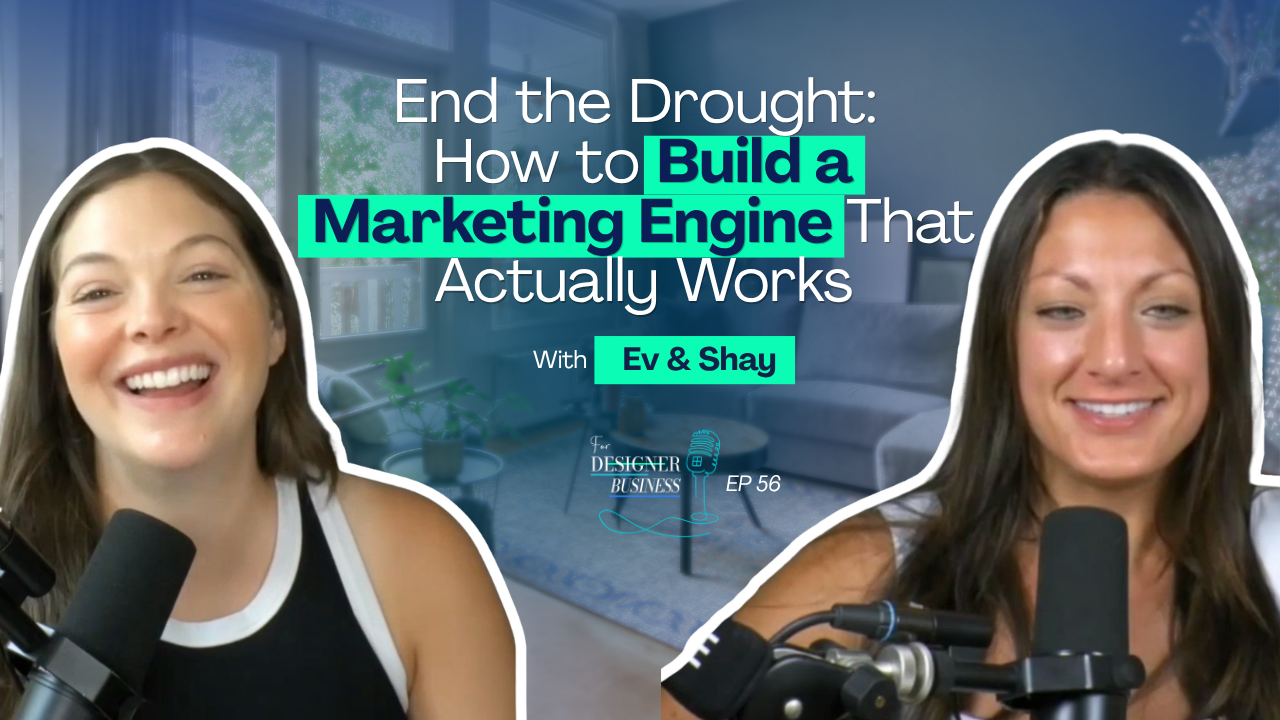
In Episode 56 of For Designer Business, Shayna and Evelyn break down why that cycle happens and what it takes to build a marketing engine that continues working even when your client work gets busy.
What We're Getting Into in This Episode
Why getting busy can actually create your next client drought
How to keep marketing consistent when you are already stretched thin
Why social media shouldn't automatically be your first marketing priority
How email marketing, SEO, Pinterest, blogging, and Google Business Profile can support your visibility
Why SEO requires a long-term approach instead of an immediate payoff
How to choose one marketing channel and commit to it instead of constantly starting over
Why Your Business Keeps Going From Swamped to Dry
Interior design is project-based work. When a project is demanding your attention, it makes sense that client work becomes the priority.
The problem starts when marketing disappears completely.
When you're busy, you're focused on client satisfaction, completing projects, and bringing in billable work. The activities happening behind the scenes that create future visibility often get pushed aside.
Then the work slows down.
And because the marketing engine was turned off weeks or months earlier, there isn't enough activity feeding the pipeline.
That's not necessarily an ebb and flow problem. It's a consistency problem.
Normal ebbs and flows will happen in any design business. The goal isn't to eliminate them. The goal is to build a baseline of marketing activity that continues through those seasons.
What to do instead
If you're drowning in client work, you don't necessarily need to generate more leads immediately. You may need to adjust your lead times and client expectations while keeping your marketing moving.
That could mean continuing your email marketing, maintaining your social presence, publishing content, networking, or working on your SEO.
The specific channel can change.
The consistency can't.
You Don't Need to Do Every Marketing Channel at Once
When an interior designer realizes their marketing has fallen off, the natural reaction is often:
"Okay, I need to do everything."
Social media. Email. SEO. Blogging. Pinterest. Networking. LinkedIn.
That quickly becomes another overwhelming list that never gets completed.
Instead, start by asking a different question:
What can I leverage first?
For example, social media can be useful if you already have quality photography and video content to work with. If you're consistently capturing project images and footage, that content can become something a team can help you turn into marketing assets.
But if creating that content is already difficult, social media may not be the only place you should be investing your attention.
Your marketing strategy should work with the resources you actually have.
Email Marketing Can Be One of Your Easiest Starting Points
You probably already have something valuable sitting in your business:
Email addresses.
Past clients. Prospects. Industry contacts. Builders. People who have already interacted with your business.
You don't necessarily need a complicated CRM or an elaborate automation system to begin. The episode points out that even starting with a basic list and sending a newsletter periodically is still meaningful marketing activity.
Then, as your strategy matures, your email marketing can become more intentional.
Instead of sending the exact same message to everyone, you can segment your audience.
A past client may need a different message than a builder you've networked with.
And instead of asking, "What should I send?", start asking:
Who is this for, what do they need to hear, and what action do I want them to take?
That's where email starts becoming a strategic marketing channel instead of simply another newsletter on your to-do list.
SEO Is a Long Game, Not a Quick Fix
If you've ever searched for ways to get more interior design leads online, SEO has probably come up.
And it can be tempting to think of SEO as something you start today and expect to see results from next week.
That's not how it works.
SEO is a long-term strategy. It involves your website, keywords, content, ongoing updates, and the overall relevance of your online presence.
For interior designers, blogging can be particularly useful because finished project photography isn't always available every week or even every month.
A blog gives you another way to consistently add relevant content to your website.
You can use keyword research and competitor research to identify topics that make sense for your business and the people you want to reach.
And don't overlook Pinterest
Pinterest can be easy to dismiss because it feels like a social media platform.
But in the episode, Evelyn points out an important distinction: Pinterest functions as a search engine.
A well-optimized pin can continue sending traffic to your website over time, particularly when it is connected to relevant keywords and useful website content.
The same long-term thinking applies to your Google Business Profile.
Keeping your profile active, posting updates, and using geo-tagged imagery can support local visibility when potential clients search for interior designers in a particular location.
The Real Marketing Strategy Is Consistency
At this point, you might be thinking:
"This is a lot. I'm already underwater."
That's exactly why you shouldn't try to implement everything at once.
The goal isn't to build the most complicated marketing strategy possible.
The goal is to build a marketing foundation you can actually maintain.
Think about the seed analogy from the episode.
You plant the seed. You cover it with soil. You nurture it.
But if you keep digging it back up every time you get busy, then putting it back in the ground when things slow down, you're constantly starting over.
Marketing works much the same way.
You may not see immediate results. That's normal.
But stopping and restarting makes it much harder for your strategy to build momentum.
Marketing isn't a faucet you turn on and off. It's a funnel that needs consistency.
So instead of asking, "What can I do to get leads right now?", consider asking:
"What can I start consistently doing now that will make lead generation possible later?"
That's a much more sustainable question.
Pick One Marketing Channel and Keep the Generator Running
You don't need to fix your entire marketing strategy this week.
Start with one channel that makes sense for where your business is right now.
Maybe that's email because you already have a list.
Maybe it's social media because you're already creating strong visual content.
Maybe it's SEO because you want to build toward people finding you through search.
Whatever you choose, give it enough time to work.
The episode's action step is simple: pick one marketing channel and commit to it without pulling back the second things get busy.
That doesn't mean your strategy can never change.
It means you're giving your strategy a chance to actually build momentum before abandoning it for the next thing.
Stop starting over. Start building.
“Standout Lines”
“Marketing is not a faucet that you just turn on and leads start coming out.”
“The seed needs to go in the ground, and it needs to be covered with soil.”
“Pick one marketing channel and commit to it without pulling back the second things get busy.”
Your Marketing Strategy Doesn't Need to Be Perfect
If your design business is currently stuck in the cycle of busy, dry, busy, dry, don't assume you need a completely new business model.
Start by looking at what happens to your marketing when things get busy.
Does it disappear?
If it does, that's a place to start.
Choose one marketing channel. Build a realistic rhythm around it. Keep showing up when client work gets demanding. Give the strategy time to compound.
You don't need to do everything today.
You need to stop starting over.
If this is something you've been navigating, listen to Episode 56 of For Designer Business, “End the Drought: How to Build a Marketing Engine That Actually Works.” The full conversation goes deeper into how social media, email, SEO, Pinterest, networking, and other marketing efforts can work together to create a stronger foundation for lead generation.
And if you know you need consistency but don't have the time or team to make it happen, 4Dbiz can help you build that foundation. The goal isn't overnight lead generation. It's creating the consistency that makes lead generation possible over time.
You can build this. Start with one thing, follow the strategy, and give it the time it needs to work.
FAQs
How can interior designers get more consistent leads?
Start by building a consistent marketing strategy rather than relying on marketing only when your pipeline is slow. Email, social media, networking, SEO, blogging, Pinterest, and Google Business Profile can all contribute to visibility and lead generation over time.
Why does my interior design business keep going through busy and slow seasons?
Some business fluctuation is normal. However, repeatedly moving from extremely busy to extremely slow can happen when marketing activities stop during busy periods, leaving little activity to support the future pipeline.
Is social media enough for an interior design marketing strategy?
Social media can support your online presence, particularly when you have strong photography and video content. But the episode emphasizes that it should not necessarily be the only marketing channel. Email, networking, SEO, and other organic marketing efforts can work alongside it.
How long does SEO take for an interior design business?
SEO is presented in the episode as a long-term strategy rather than an immediate lead-generation tool. Building visibility can involve keyword research, website optimization, blogging, ongoing content updates, Pinterest, and local search efforts.
Your business gets busy, so marketing gets pushed aside. Then the projects end and your pipeline feels empty. Listen to the newest For Designer Business episode to learn why consistency matters and how to keep your marketing engine running.